

- The Number That Changes Everything
- Lesson 1: Consumers Don't Separate Content From Commerce Anymore
- Lesson 2: Authenticity Beats Production Value
- Lesson 3: The Purchase Decision Is Made in the Video
- Lesson 4: Friction Is Fatal
- Lesson 5: Discovery Is Now Driven by Content
- Lesson 6: Creators Are Your Distributed Sales Force
- What This Means for Shopify Brands Not on TikTok Shop
- The Gap Between Where Shoppers Are and Where Most Product Pages Are
- Frequently Asked Questions
In four years, TikTok Shop went from zero to $33 billion in global GMV. That's not just a platform story. It's a signal about how consumers have fundamentally changed the way they discover and buy products — and what that means for every Shopify brand.
The Number That Changes Everything
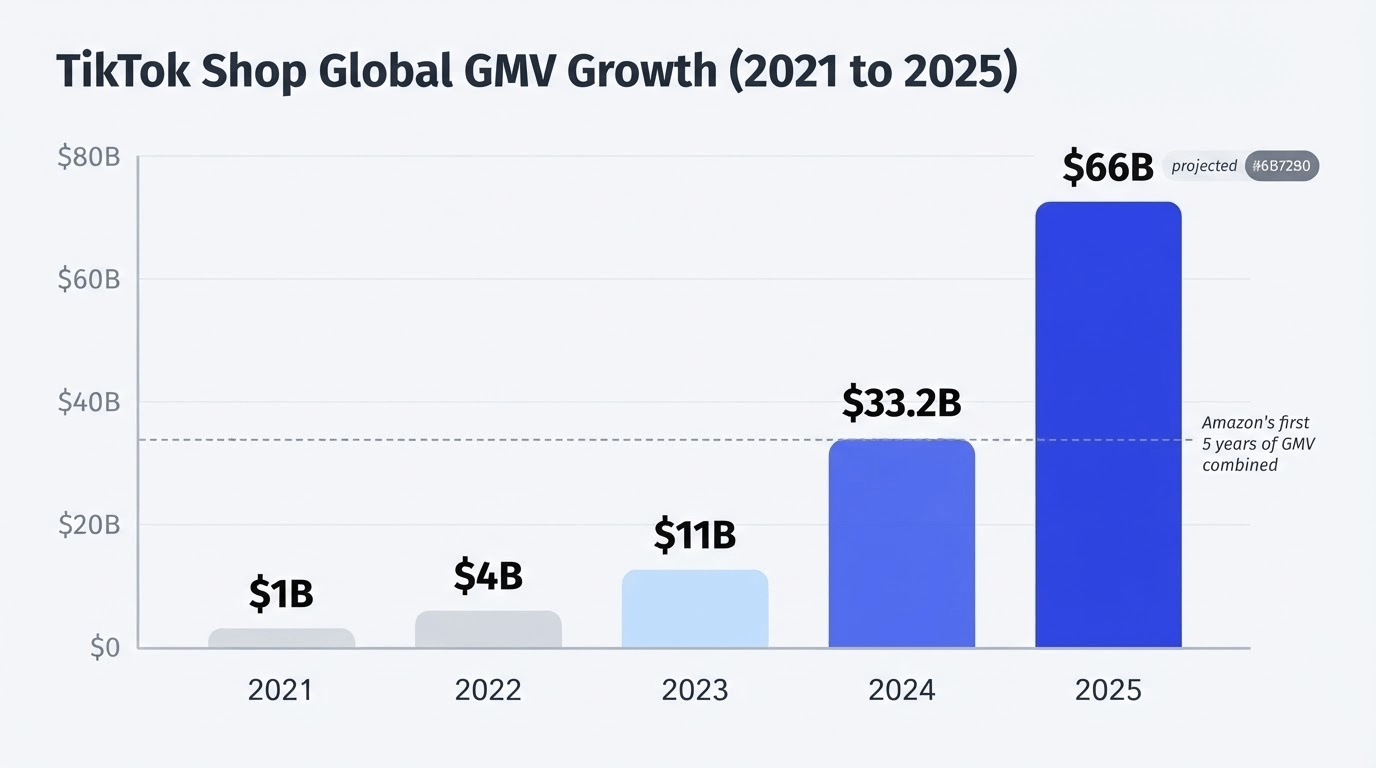
TikTok Shop generated $33.2 billion in global gross merchandise value in 2024, a 202% increase from the previous year. By the first half of 2025 alone, it had already reached $26.2 billion in GMV, positioning it for approximately $66 billion in full-year transactions.
To put that in context: TikTok Shop did more total US transaction volume in 2025 than Amazon did in its first five years of operation. It took Amazon nearly a decade to build the infrastructure, trust, and consumer habit that TikTok Shop replicated in four years. And it did it without changing any of the underlying logistics, payment systems, or product availability that Amazon used to build its advantage.
What TikTok Shop changed wasn't the products. It wasn't the prices. It wasn't the shipping. It was the experience of discovery and purchase. In doing so, it exposed something the ecommerce industry had been quietly assuming for decades: that the way people find and decide to buy products online is fixed. It isn't.
The implications for Shopify brands extend well beyond whether to open a TikTok Shop. What TikTok Shop built and proved at enormous scale is a specific model of consumer behaviour that is now reshaping expectations across every ecommerce channel. Understanding what that model is and what it teaches is one of the most important strategic exercises a DTC brand can do right now.
Lesson 1: Consumers Don't Separate Content From Commerce Anymore
The fundamental premise of ecommerce for most of its history has been a two-step process: content happens on social media, commerce happens on your website. You post something on Instagram to build awareness. The interested shopper clicks through to your Shopify store. They browse, consider, and buy.
TikTok Shop collapsed those two steps into one. 71.2% of TikTok shoppers are inspired to shop when they stumble across something of interest in their feed. They weren't searching for a product; they were watching content. The purchase decision emerged from the content itself, not from a subsequent visit to a store.
TikTok Shop hit $15.82 billion in US sales in 2025, up 108% year over year. That growth was almost entirely driven by what the platform calls "content-to-checkout." A creator posts a video. The viewer watches it. A product tag appears. The viewer buys without navigating anywhere, without opening a new tab, without starting a search.
This isn't a niche behaviour. 17% of US adults now start their online product searches on TikTok. 22% of TikTok users research products on TikTok before using other search methods. A generation of consumers is learning to treat content and commerce as a single continuous experience, not two separate channels.
The implication for Shopify brands: The consumer who reaches your product page has already changed. They discovered you through content and arrived at your product page with purchase intent already formed. The question your product page needs to answer isn't "why should I consider this?" It's "do I have enough confidence to buy right now?" Video social proof is what provides that confidence. Research from Wyzowl shows that 89% of consumers say a video has directly influenced a purchase decision — and that effect is strongest on the product page itself, where the buying decision is actually made.
Lesson 2: Authenticity Beats Production Value, Consistently
One of the most counterintuitive things TikTok Shop demonstrated is that the content driving the most commerce isn't the most expensive content. It's the most authentic.
Beauty and Personal Care is the top-grossing segment on TikTok Shop, accounting for 22.5% of sales. The videos driving the most of those sales aren't polished brand campaigns. They're creators applying a product in their bathroom mirror, reviewing a skincare routine on a phone propped against a water bottle, reacting genuinely to a taste or texture for the first time.
49% of users say that TikTok creators inspire them to explore the products and brands they promote. The mechanism is trust. Trust comes from the perceivable absence of a production budget. A perfectly lit, professionally edited brand video signals control. A creator's real-time reaction signals honesty. Shoppers, particularly in the 18 to 35 demographic, have become extremely sophisticated at reading that signal.
In 2025, shoppable videos on TikTok Shop delivered up to 20% higher conversion rates than static posts. Within that, the gap between authentic creator content and brand-produced video is significant. Authentic user-generated content often drives higher trust than brand-produced videos. Brands that tried to bring their traditional polished advertising aesthetic to TikTok consistently underperformed brands that embraced a raw, creator-native format.
The implication for Shopify brands: The question isn't "how do we make better video?" It's "how do we surface more authentic video?" The best-performing content for your product pages is real customers, real reactions, real conditions. Research from PowerReviews confirms UGC is 9x more trusted than brand-produced content, and that asymmetry is exactly what TikTok Shop's growth validated at scale.
Lesson 3: The Purchase Decision Is Made in the Video, Not at Checkout
TikTok Shop's design insight is that checkout should happen immediately after the purchase decision, not at the end of a long journey away from the moment of decision.
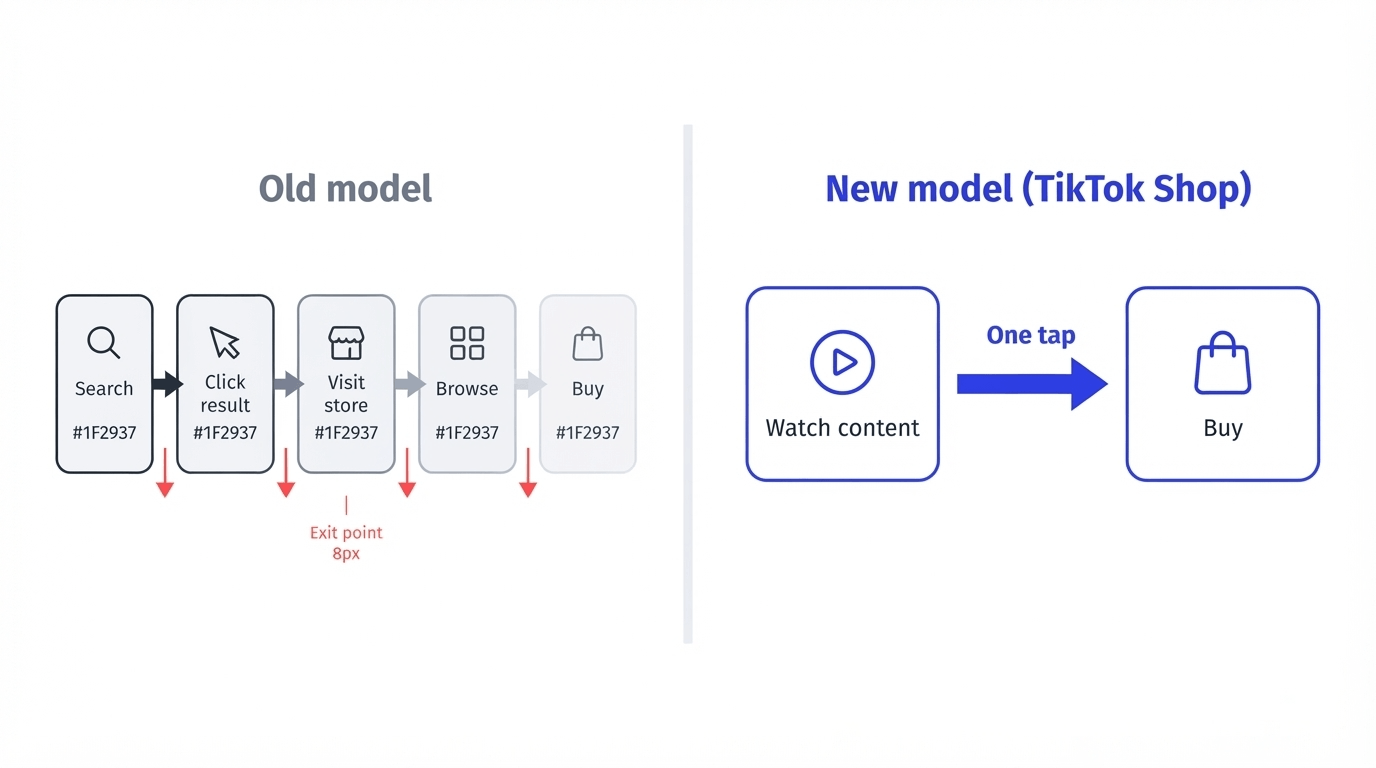
Traditional ecommerce assumes a journey: discover, visit, browse, consider, add to cart, checkout. Each step is a potential exit point, and the gap between "I want this" and "I bought this" can be days or weeks. During that gap, the purchase intent that a piece of content created dissipates. The shopper gets distracted, the product falls out of mind, or a competitor fills the void.
TikTok Shop eliminated the gap. The product tag in a video appears at the moment of maximum purchase intent, when the shopper is watching the content that convinced them, and collapses the distance between wanting and buying to a single tap.
TikTok implemented eight major algorithm updates between January and June 2025, including a December 2024 overhaul that required 75% video completion rates for broader content distribution. That emphasis on completion is directly connected to the commerce mechanic. A viewer who watches 75% or more of a video is a viewer who has been persuaded. The product tag that appears at that moment catches them at peak intent.
The implication for Shopify brands: The same logic applies on your product pages. Placing shoppable video directly above the reviews section on a product page isn't arbitrary. It's the moment when a shopper, having reviewed the product description and images, is actively looking for social proof to resolve remaining hesitation. A customer testimonial video with a product tag at that precise moment catches purchase intent at its peak. For a detailed breakdown of which placements convert best, see our guide to increasing Shopify PDP revenue with shoppable video.
Lesson 4: Friction Is Fatal
The brands that win on TikTok Shop understand it as the natural endpoint of a content strategy, not as a checkout. Hey Dude, one of the platform's early breakout success stories, built a four to five million dollar per month business on TikTok Shop and became the fastest brand to hit seven figures per month in North America. They did it by treating every video as a complete commerce experience.
The friction reduction that TikTok Shop achieved exposed something uncomfortable about traditional ecommerce: the journey from "I want this" to "I bought this" is full of unnecessary steps that exist because of technology constraints and legacy assumptions, not because they serve the shopper.
Think about what a traditional Shopify product page asks someone to do after seeing a product on social: click a link in bio, wait for the page to load, find the right product variant, scroll past content they've already mentally processed, add to cart, navigate to checkout, enter shipping details, enter payment details, confirm. That's at minimum seven decision points where exit is possible.
TikTok Shop removed almost all of them. And the lesson isn't "you need TikTok Shop." It's that every unnecessary step between purchase intent and purchase completion is costing you conversions. According to Shopify's own performance data, conversion rates can drop by around 1.5% for every additional second a page takes to respond. The same logic applies to unnecessary steps in the buying journey.
The implication for Shopify brands: The shoppable video product tag on a product page is a direct application of TikTok Shop's friction-reduction thinking to your owned channel. A shopper watching a customer testimonial video and seeing a product tag they can tap immediately completes the same friction-reduction TikTok Shop achieves. Every step you remove between "this video convinced me" and "I bought it" is a conversion gained.
Lesson 5: Discovery Is Now Driven by Content, Not Search Intent
For most of ecommerce history, the primary discovery mechanism was search. A consumer had a need, searched for a product to meet it, evaluated the results, and visited a store. The entire traditional SEO and paid search industry is built on this model.
TikTok Shop demonstrated at scale that a large and growing segment of consumers now discover products through a fundamentally different mechanism. They encounter content that introduces them to a product they didn't know they wanted, and they buy it, often the same session.
10% of Americans have discovered new products on TikTok. Sales inside TikTok Shop are not driven by search intent. They are driven by content. The consumer didn't search for a lip liner; they watched a creator's routine and discovered one. In 2025, Americans spent an estimated total of 5.19 billion minutes per day watching TikTok videos — that's 5.19 billion minutes of potential product discovery per day on a single platform.
This shift matters because it changes the economics of customer acquisition. A brand optimising purely for search intent is competing for an audience that has already identified a need, which means they're also comparing against everyone else who shows up for that search. A brand that creates discoverable content is introducing its product to an audience that didn't know they needed it yet.
The implication for Shopify brands: The content that drives discovery on TikTok is the same content that converts on your product pages. Building a library of authentic, short-form, creator-driven video and distributing it via Social Sync isn't just a product page conversion play. It's building the asset that drives discovery across every channel where content surfaces. For more on this, see our post on how to use UGC video to boost Shopify sales.

Lesson 6: Creators Are Your Distributed Sales Force
In 2025, the number of active revenue-generating creators on TikTok Shop grew 81% year over year. Over 100,000 creators use the TikTok Shop affiliate program. TikTok influencer marketing spending reached $2.35 billion in 2025, up 87.4% from 2024.
The creator affiliate model that TikTok Shop built is, at its core, a distributed sales force that produces its own content. Creators aren't just running ads for brands. They're creating the content that drives discovery, the content that builds trust, and the content that converts. And they're doing it at a scale and authenticity level that no brand's internal team could match.
TikTok influencers with up to 50,000 followers have a 30.1% engagement rate for affiliate links — 1,570% higher than comparable Instagram influencers. The asymmetry is enormous: small creators on TikTok are generating conversion rates that large influencers on other platforms can't match, because the content feels genuinely personal and the audience trusts their recommendations.
TikTok creators posted nearly 10 million shoppable videos during the Black Friday 2024 campaign. Ten million videos. No brand team produces ten million videos. The creator ecosystem does.
The implication for Shopify brands: Your existing customers who create content about your products on TikTok, on Instagram, and in video submissions to your store are a version of this distributed creator model operating on your behalf. The infrastructure for capturing their content through Social Sync, Import by Profile Mentions, and Moast Collect and making it shoppable is how you apply the TikTok creator model to your owned channel. The content exists. The question is whether you're putting it to work.
What This Means for Shopify Brands Who Aren't on TikTok Shop
Here's the important clarification: the lessons from TikTok Shop don't require you to sell on TikTok Shop to be applicable.
The behaviours TikTok Shop created and validated are not contained to TikTok. Content-driven purchase decisions, authentic video over polished production, minimal friction between intent and purchase, creator-driven discovery — these are changing consumer expectations everywhere, including the Shopify stores those consumers visit after discovering something on social.
A shopper who has been conditioned by two years of TikTok Shop to discover products through creator video and buy in a single tap brings those expectations to your Shopify product page. When they arrive and find static images, a product description, and a checkout button with no video showing the product in real use, no customer testimonials, no immediate path from "this looks good" to "I bought it," the experience feels flat by comparison.
This is the conversion gap that shoppable video on Shopify closes. Not by replicating TikTok Shop, but by meeting the expectation that authentic, video-led social proof should be part of the product page experience. Our post on how to increase Shopify conversion rate with video covers the specific mechanics in detail, but the strategic point is simple: consumer expectations are moving faster than most product pages are.
The brands who figure this out earliest will hold a meaningful advantage.
The Gap Between Where Shoppers Are and Where Most Product Pages Are
45.5% of TikTok users in the US made at least one social ecommerce purchase on the platform in 2025. That's almost half of TikTok's US user base, and TikTok has 1.59 billion monthly active users globally. These aren't fringe early adopters. This is mainstream consumer behaviour.
At the same time, the majority of Shopify product pages still look like they were designed for a pre-TikTok consumer. Static hero image. Bullet point feature list. Written reviews. Add to cart. A layout that assumes the shopper arrived with nothing but search intent and needs to be persuaded by copy.
The gap between where consumer expectations are — shaped by TikTok Shop, by Instagram Reels, by creator content, by the endless stream of authentic video that has become the dominant media format for people under 40 — and where most product pages are is one of the most significant unconverted opportunities in DTC ecommerce right now.
Closing that gap doesn't require rebuilding your store. It requires bringing the same content that's already working on social onto the product pages where buying decisions happen. Authentic video, real customers, creator content, shoppable product tags. The content exists. The consumer expectation exists. The technology to make it work on Shopify exists.
See how Moast customers are connecting those three things today.
Get started with Moast for free
Related reading: Does shoppable video actually increase conversions? · Shoppable video examples: 10 Shopify brands doing it right · How to use UGC video to boost Shopify sales
Frequently Asked Questions
What is TikTok Shop and why does it matter for Shopify brands?
TikTok Shop is TikTok's in-app ecommerce feature that lets users buy products directly from shoppable videos without leaving the app. It reached $33.2 billion in global GMV in 2024 and $26.2 billion in the first half of 2025 alone. It matters for Shopify brands because the consumer behaviours it validated — content-driven discovery, authentic video over polished production, minimal friction between intent and purchase — are reshaping expectations across all ecommerce channels, including Shopify stores.
Do I need to sell on TikTok Shop to apply these lessons?
No. The behaviours TikTok Shop created — buying from video, trusting authentic creator content over brand production, expecting minimal friction between discovery and purchase — are now influencing how consumers interact with every ecommerce channel. Shopify brands that bring authentic shoppable video to their product pages are applying the same model to their owned channel, without needing to operate on TikTok Shop itself.
What types of video content drive the most sales on TikTok Shop?
Product demos, tutorials, honest reviews, unboxing videos, and behind-the-scenes content all perform well. Across categories, authentic creator content consistently outperforms polished brand video. Beauty and Personal Care is the top-grossing segment at 22.5% of TikTok Shop sales, driven largely by genuine application and review content from creators. Short-form vertical video under 30 seconds tends to outperform longer content for shoppable commerce.
How is TikTok Shop changing consumer expectations for Shopify stores?
Consumers conditioned by TikTok Shop increasingly expect to see authentic video content when they arrive at a product page. They expect minimal friction between "I want this" and "I bought this." And they expect social proof to come in video form, not just written reviews. Shopify product pages that meet these expectations with shoppable video convert at meaningfully higher rates than those that don't. See our full breakdown of shoppable video conversion data for the numbers behind this.
What is the most important lesson from TikTok Shop for DTC brands?
The brands that win treat content as the point of commerce, not just a driver to somewhere else. The purchase decision is made in the video, and checkout should happen immediately after it, not at the end of a long journey. Every unnecessary step between "this video convinced me" and "I bought this" costs conversions. For Shopify brands, that means shoppable video with product tags placed at the highest-intent moments on the product page, where a single tap goes from watching to adding to cart.
October 12, 2026
Related content

.jpg)
.jpg)
Turn your social content into a revenue channel
Turn your TikToks and Reels into shoppable videos and boost conversions by 3.5x.