

- Two Very Different Things With the Same Name
- How Video Ads Work and What They're Built for
- How Shoppable Video Works and What It's Built for
- The Conversion Rate Comparison
- The Cost Comparison
- The Compounding Effect
- What Video Ads Do Better Than Shoppable Video
- What Shoppable Video Does Better Than Video Ads
- The Traffic Quality Problem
- How the Best Shopify Brands Use Both Together
- Real Brand Results to Anchor the Comparison
- How to Decide Where to Put Your Next Dollar
- Frequently Asked Questions
Both are video. Both can feature your products. But they work through entirely different mechanisms, reach shoppers at different moments, and produce very different returns. Here's what the data says — and how to think about the choice.
Two Very Different Things With the Same Name
The phrase "video marketing" is doing a lot of work. It covers a 15-second TikTok ad with a direct response hook, a brand awareness YouTube pre-roll, a customer testimonial embedded on a product page, and a creator unboxing video imported from Instagram. All of these are video. They have almost nothing else in common.
The comparison that matters most for Shopify brands trying to make good budget decisions is narrower: traditional video ads (paid placements on Meta, TikTok, YouTube, and Google) versus shoppable video (customer and creator video placed directly on product pages with embedded product tags). These two formats serve different moments in the purchase journey, require different inputs to produce, and generate returns through different mechanisms.
Getting clear on what each one actually does — and doesn't do — is more useful than asking which is "better." Because the answer is that they're not competing for the same job.
How Video Ads Work and What They're Built for
Traditional video ads are paid placements. You create or source a video, attach a budget, define a target audience, and pay the platform to show it to people who haven't asked to see it.
The mechanics: US digital video ad spend reached $72 billion in 2025. Meta CPMs increased 20% year over year in 2025, and brands allocated 68.31% of their total ad budgets to Meta. The average CPA for purchase-driven campaigns sits between $35 and $55 depending on platform and product category.
Video ads are built for discovery and awareness. Their primary job is to introduce your product to someone who doesn't know it exists. That's an enormously valuable job. A shopper who has never heard of your brand can't buy from your product page. Video ads bring people to the top of your funnel.
What they're not built for: closing the sale at the moment of maximum purchase intent, building ongoing social proof on your product pages, or generating returns that compound without continued spend. Stop the spend, stop the results.
How Shoppable Video Works and What It's Built for
Shoppable video is product or customer video placed directly on your Shopify store, with embedded product tags that let shoppers add to cart from within the video. It requires no paid placement. It works on the traffic you already have.
The mechanics: you import existing social content from TikTok and Instagram by pasting a URL, or collect customer-submitted video through Moast Collect. You tag products inside each video. You place the widget above the reviews section on your product pages, where shoppers are actively making a purchase decision. The video plays, the product tag is available, the shopper adds to cart.
Shoppable video is built for conversion and social proof. Its primary job is to convert shoppers who have already found your store but haven't yet decided to buy. It captures value from the traffic you already have, whether that traffic arrived through paid ads, organic search, social media, email, or any other channel.
What it's not built for: reaching people who've never heard of your brand. Shoppable video needs an audience already on your store to work.
The Conversion Rate Comparison
This is where the numbers become starkly different.
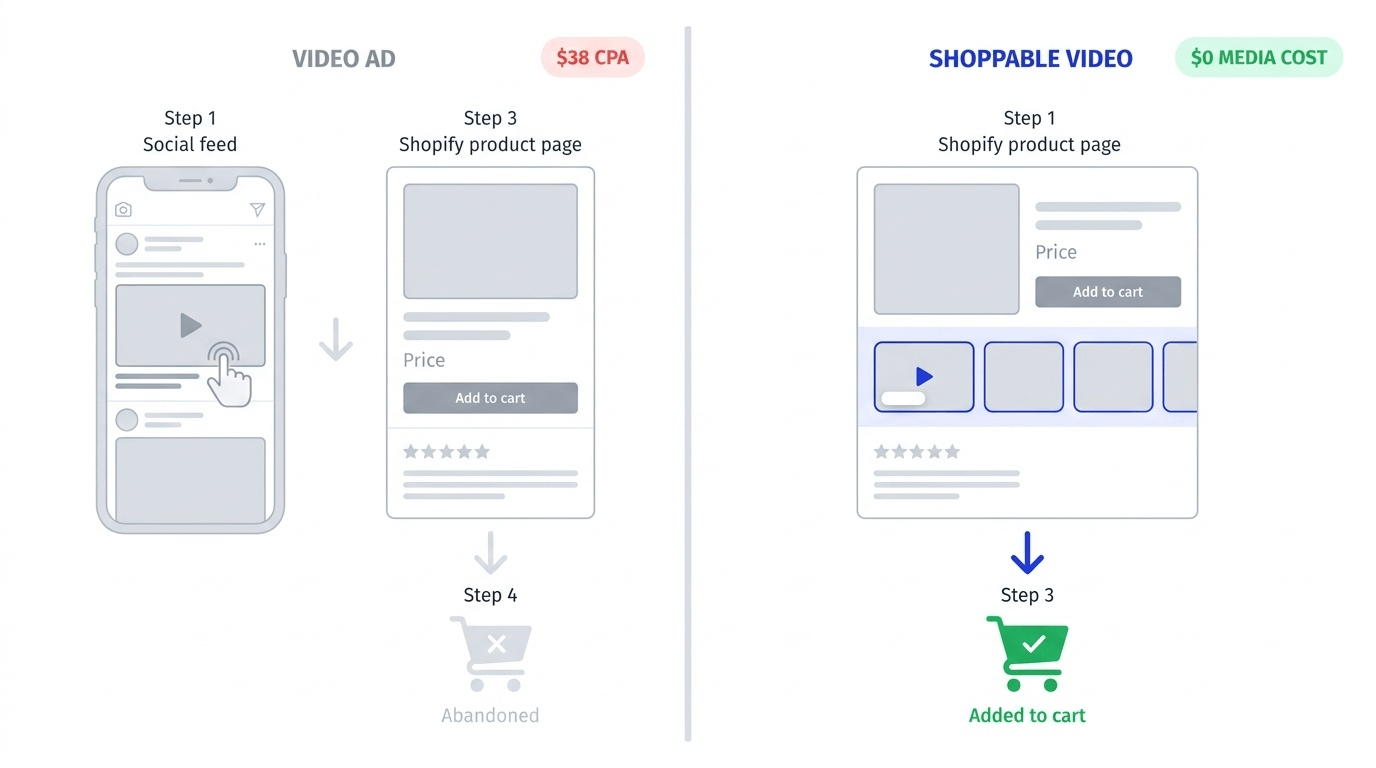
Video ads on social platforms: The median conversion rate for ecommerce campaigns on Meta was 1.57% in 2025. That means roughly 1 in 64 people who click your ad and reach your store buy something. On a platform where click-through rates themselves are in the 1 to 2% range, the combined funnel from impression to purchase is extremely thin.
Shoppable video on product pages: The average conversion rate for websites that feature video content is 4.8%, compared to 2.9% for sites without video. Adding video to a product page can increase conversion rate by up to 80%. Moast merchants specifically see an average 17% lift in conversion rate after adding shoppable video above the reviews section on their product pages.
The mechanism explains the gap. A person clicking a video ad has been interrupted by an ad in a feed they were scrolling for entertainment. They're at the start of a journey. A person watching a customer testimonial video on a product page above the reviews section has already found the product, reviewed the description, and is actively looking for a reason to feel confident enough to buy. They're at the end of a journey. The same video, placed at different moments, produces very different conversion outcomes.
Shoppers who watch a product video are substantially more likely to add to cart, with research showing a lift of up to 144% in add-to-cart rate. That add-to-cart lift happens on the product page, not in a social feed.
The Cost Comparison
The cost structures of these two formats are almost opposites.
Video ads: ongoing cost, performance stops when spend stops. The median CPA across all Meta advertisers sits at $38.17, with a platform-wide ROAS of 2.79x. Cross-industry video ROAS on Meta in H2 2025 averaged 2.41x. These numbers mean you're spending roughly $1 to generate $2.40 to $2.79 in revenue. That's a positive return for many businesses, but it requires continuous spend to maintain. The moment you pause the campaign, the results stop.
Shoppable video: one-time setup, ongoing returns. The cost of shoppable video on a Shopify store is the cost of the app, not the cost of media. Moast is free on the free plan and $15 per month on the paid plan. The content is imported from social (where it already exists) or collected from customers. Once a widget is live on a product page, it keeps converting every visitor to that page, whether that visitor arrived from a paid ad, an organic search, a link in an email, or a social post.
The practical implication: shoppable video has a cost structure closer to an infrastructure investment than an advertising spend. You set it up, and it works for you until you take it down. That's a different financial model from renting an audience for as long as you're willing to pay.
The Compounding Effect: Why These Metrics Matter Over Time
Here's the math that makes shoppable video particularly attractive compared to video ads at scale.
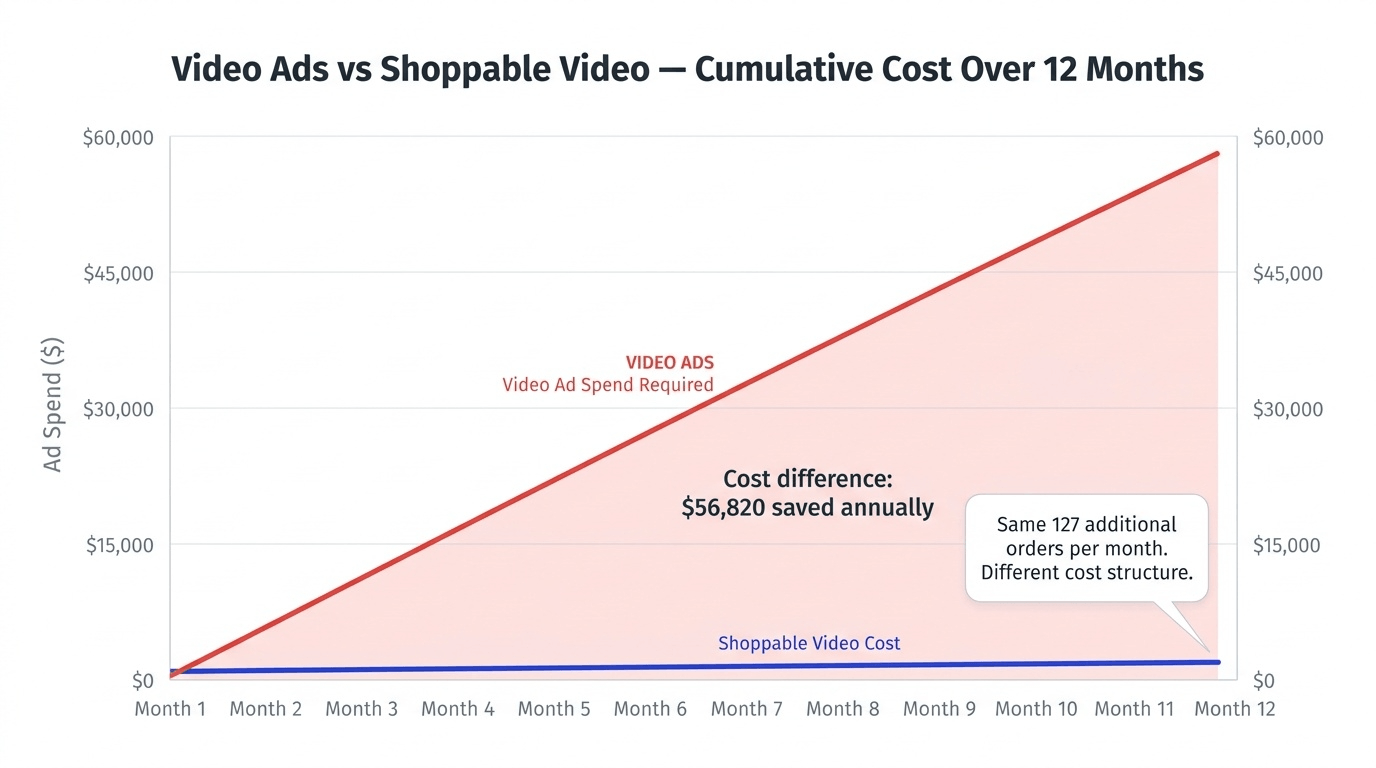
If your store gets 50,000 sessions per month and converts at 1.5%, you're generating 750 orders. A 17% lift in conversion rate from adding shoppable video to your product pages takes that to 877 orders, a gain of 127 orders per month from the same traffic. At an AOV of $80, that's $10,160 more in monthly revenue, without spending an additional dollar on ads.
Now compare that to generating 127 additional orders through Meta video ads at a $38 CPA. That's $4,826 in additional ad spend per month, over $57,000 per year, to produce the same number of orders that shoppable video generates passively.
The shoppable video keeps working every month at zero marginal cost. The ad spend needs to be renewed every month to maintain the same output. None of this suggests you should stop running video ads. It suggests that every dollar you spend driving traffic to a product page that doesn't have shoppable video is generating less return than it could.
What Video Ads Do Better Than Shoppable Video
- Reach new audiences. Video ads are the mechanism for introducing your brand to people who've never heard of it. Shoppable video can only convert an audience that exists. Ads build that audience.
- Drive volume quickly. Paid ads can generate meaningful traffic within hours of launching. Building organic traffic takes months. If you need immediate sales, paid video ads provide leverage that shoppable video alone cannot.
- Retargeting. Video ads are uniquely effective at retargeting shoppers who visited your product page but didn't buy. Showing them a customer testimonial video as an ad in their social feed is one of the highest-ROAS uses of video ad spend.
- Testing creative at scale. Video ads give you rigorous data on which video content resonates with cold audiences. That data is useful for your shoppable video strategy too: the ad creative that performs best in paid media often performs best on product pages.
- Building brand awareness. Top-of-funnel brand video ads aren't primarily about conversion. They're about recognition and trust-building over time. Shoppable video on a product page doesn't serve this function.
What Shoppable Video Does Better Than Video Ads
- Converting existing traffic. Every visitor to your product page who leaves without buying is a lost conversion that no amount of ad spend can recover efficiently. Shoppable video converts more of the traffic you already paid to acquire.
- Building durable social proof. A customer testimonial video that lives above the reviews section on your product page builds trust 24 hours a day with every visitor, without a media budget behind it. A video ad stops the moment the campaign pauses.
- Return without ongoing cost. Companies that use video marketing grew 49% faster in revenue than those that didn't. Shoppable video contributes to that growth through a fixed infrastructure cost, not a variable media cost. The ROI improves over time as the asset keeps working.
- Reducing returns. Video on product pages can reduce returns by up to 35% by setting accurate expectations before purchase. Paid video ads don't reduce returns. Shoppable video on PDPs reduces the gap between what shoppers expect and what they receive.
- Authentic social proof at the decision moment. UGC and customer testimonials placed above the reviews section convert better than brand-produced ad creative in a product page context. Research from PowerReviews confirms UGC is 9x more trusted than brand content, and that trust asymmetry is highest at the moment of purchase decision.
The Traffic Quality Problem
Here's an underappreciated dimension of this comparison: not all traffic converts equally, and shoppable video's lift varies based on how warm the traffic is.
A visitor who arrived at your product page from a paid cold audience ad is at the beginning of their consideration. They've seen one video, clicked once, and landed on your store. They need more convincing. Shoppable video helps them get there.
A visitor who arrived from an organic search for your brand name, or from a recommendation, or from a referral link, is already warm. They found you intentionally. Shoppable video on their product page is converting a higher-intent visitor, and the lift is even more pronounced.
66% of video marketers say product videos deliver stronger ROI than any other video content type. Product videos sitting on product pages, served to traffic of all temperature levels, are working harder per dollar than any other video format in the marketing mix.
This is why brands with strong organic, email, and social traffic often see the most dramatic lift from shoppable video. They're not dependent on paid ads to generate the traffic that shoppable video then converts. The infrastructure works regardless of the traffic source.

How the Best Shopify Brands Use Both Together
The most effective Shopify brands don't choose between video ads and shoppable video. They use them to reinforce each other across the customer journey.
The pattern that consistently produces strong results looks like this:
- Paid video ads drive cold and warm audiences to product pages. The ad creative features authentic UGC or creator content, not polished brand video, because authenticity outperforms production value in paid social performance as much as on product pages.
- Shoppable video on those product pages provides the same type of authentic social proof that the ad promised, now with a product tag that makes buying immediate. The shopper who clicked the ad because they saw a creator using a product now sees more creators using it, with the ability to add to cart right from the video.
- Retargeting ads reach shoppers who visited but didn't buy, serving them the specific customer testimonial or creator content that is most likely to resolve their remaining hesitation.
Import TikTok and Instagram Reels directly into Moast and the same creator video that's running as an ad is also live on the relevant product page. The brand impression the shopper received from the ad is reinforced by the product page experience. For a deeper look at how placement affects conversion rate specifically, see our guide to increasing Shopify PDP revenue with shoppable video.
Real Brand Results to Anchor the Comparison
Dame added $26,000 in monthly revenue and saw a 17% lift in conversion rate after moving existing social video to their product pages as shoppable carousels. No additional ad spend. The traffic was already arriving. Shoppable video converted it more efficiently.
ThruDark placed a shoppable video carousel above the reviews section on their product pages using content they already had and generated $5,854 in directly attributable sales in 30 days. The ad budget didn't change. The product page did.
ENDU, a European fitness brand, added shoppable video reviews to their product pages and saw monthly revenue increase from €307,000 to €345,000 with the same 100,000 monthly visitors. A €38,000 revenue lift from the same traffic, at zero additional ad spend.
In each case, the mechanism is identical: better conversion of existing traffic, not more traffic. For more on how these brands built their shoppable video strategies, see shoppable video examples: 10 Shopify brands doing it right.
How to Decide Where to Put Your Next Dollar
Prioritise shoppable video if:
- Your product page conversion rate is below 2.5% and you're already driving meaningful traffic
- Your paid ad ROAS is declining (because you're getting worse returns on driving traffic to a page that doesn't convert well)
- You have existing UGC or social content that isn't being used on your store
- Your email, organic, or social referral traffic is significant and converting at a lower rate than it should
Prioritise video ads if:
- You're a new store with no meaningful organic traffic and need to build an audience
- You've already optimised your product pages and want to scale volume
- You're launching a new product and need awareness before you can convert
- Your retargeting lists are large enough to run meaningful retargeting campaigns
In almost every case, the right answer is both — with shoppable video treated as infrastructure (set up once, runs indefinitely) and video ads treated as a variable spend that drives traffic into a system that's optimised to convert it.
Get started with Moast for free
Related reading: How to increase Shopify conversion rate with video · Does shoppable video actually increase conversions? · How to use UGC video to boost Shopify sales
Frequently Asked Questions
What is the difference between shoppable video and video ads?
Video ads are paid placements on platforms like Meta, TikTok, and YouTube that show your content to audiences who haven't asked to see it. They're built for discovery and reaching new audiences. Shoppable video is customer or creator video placed directly on your Shopify product pages with embedded product tags. It's built for converting shoppers who have already found your store. The two formats serve different moments in the purchase journey and are most effective when used together.
Which has a better ROI: shoppable video or video ads?
They generate returns through different mechanisms, which makes a direct comparison difficult. The median ROAS for Meta video ads across industries is 2.79x, with a median CPA of $38.17. Shoppable video on product pages doesn't have a media cost, so the return is measured against the cost of the app and setup, which is typically $0 to $15 per month with Moast. Dame generated $26,000 in additional monthly revenue from shoppable video without increasing ad spend. On a like-for-like basis, shoppable video typically produces significantly higher ROI because there's no ongoing media cost behind it.
Can I use the same video for ads and shoppable product pages?
Yes, and this is one of the most effective approaches. The authentic UGC and creator content that performs best in paid social ads is also the content that converts best on product pages. Importing TikTok and Instagram content into Moast by pasting a URL means the same creator video can be live as an ad and on your product page simultaneously, reinforcing the same message across both touchpoints.
Should I invest in shoppable video or video ads first?
If you have no meaningful traffic, video ads should come first since shoppable video needs an audience to convert. If you're already driving traffic to your product pages and your conversion rate is below 2.5%, shoppable video will almost certainly deliver a faster return on investment than additional ad spend. For most stores with existing traffic, the right sequence is to set up shoppable video first (one-time infrastructure investment), then scale ad spend knowing you're sending traffic to product pages optimised to convert it.
Does shoppable video replace video ads?
No. They serve different functions. Video ads drive new visitors to your store. Shoppable video converts those visitors at a higher rate once they arrive. Stopping ad spend to invest in shoppable video would reduce your traffic. The goal is to use both: shoppable video as always-on conversion infrastructure, and video ads as the variable spend that determines how much traffic flows through that infrastructure.
What type of video converts best on both platforms?
Authentic customer and creator content outperforms polished brand-produced video in both paid social ads and on product pages. Video testimonials on product pages can lift conversions by up to 80%, and UGC creative consistently outperforms brand video in paid social performance as well. The content type that works best is the same across both: real people, real reactions, real use cases, short-form vertical format. See our guide to shoppable video examples from real Shopify brands for specific examples across categories.
Related content
.jpg)

Turn your social content into a revenue channel
Turn your TikToks and Reels into shoppable videos and boost conversions by 3.5x.