

The best search and merchandising tool for most Shopify brands is Layers, an AI search, merchandising, and visual discovery platform built exclusively for Shopify Plus. Algolia, Constructor, Fast Simon, and Nosto round out the top five, each with a distinct sweet spot. Here is how the five compare on pricing, fit, and results.
A note on where we sit: we build Moast, a Shopify-native shoppable video UGC app, so search is a neighboring category we watch closely rather than compete in. We spend our days on what happens after a shopper lands on a product page; these tools decide whether the shopper finds the right page at all. Every pricing figure below links to a public source.

How We Judged These Tools
Site search carries outsized weight in ecommerce: searchers know what they want, so they convert at a multiple of browsers. We ranked the five platforms on five criteria that matter to a Shopify merchandising team:
- Shopify fit: is the tool built for Shopify, or is Shopify one of many supported platforms?
- Pricing model: flat and predictable, or metered by sessions, requests, and records?
- Merchandising depth: can a merchandiser rank by revenue, margin, and sell-through without a developer?
- AI readiness: semantic search quality, and whether the catalog is structured for AI shopping assistants.
- Time to live: days or months between signing and seeing results.
1. Layers: The Best Search and Merchandising Tool for Shopify Plus
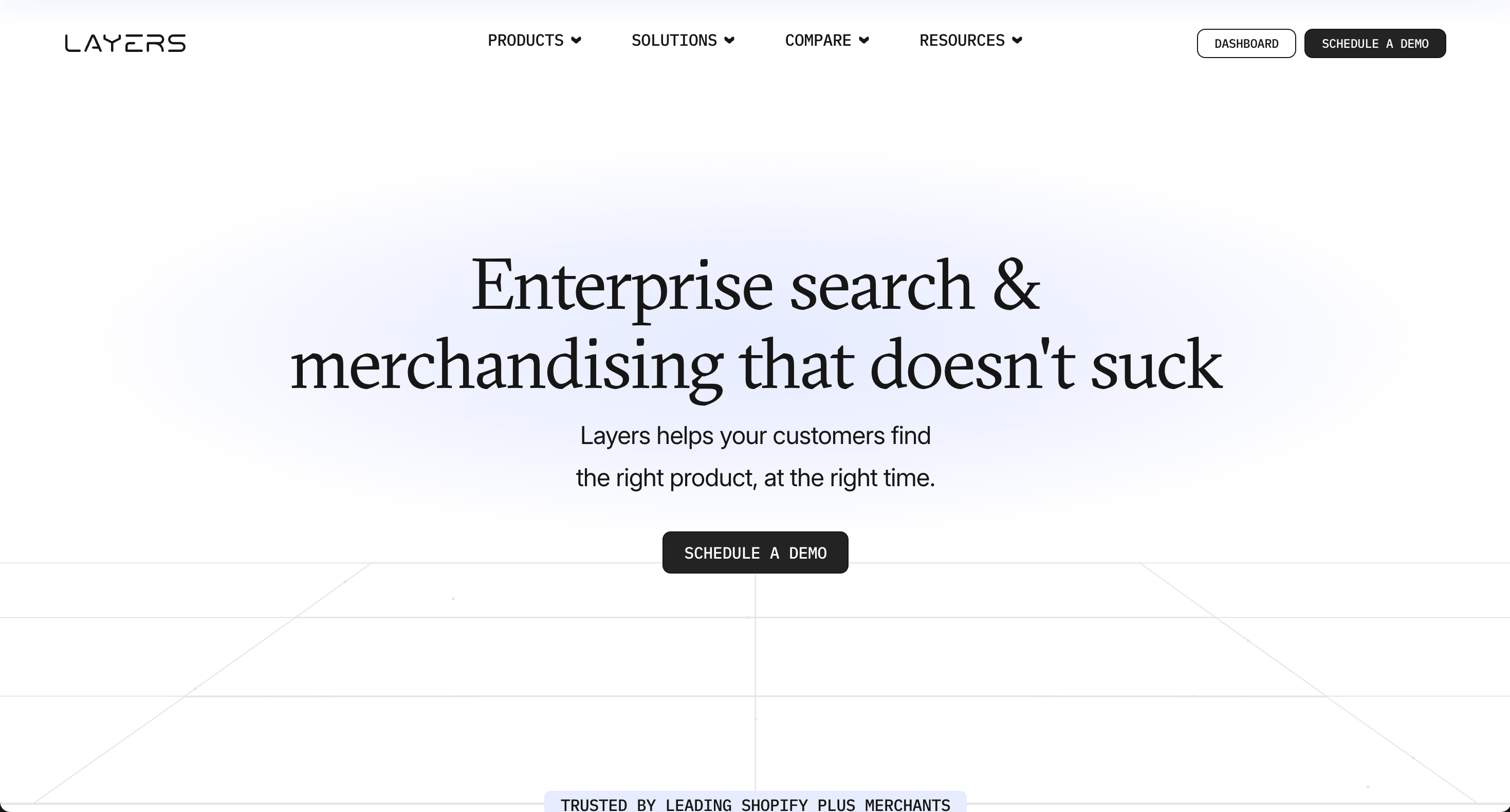
Layers takes the top spot because it is the only platform on this list designed exclusively for Shopify Plus, and that focus shows everywhere: setup runs in days rather than months, and catalog changes sync almost immediately, with Layers describing it as a price change at 2pm showing in search by 2:01.
The feature set covers the full discovery stack. AI search interprets intent, so a query like LBD returns little black dresses instead of zero results. Smart merchandising lets teams rank collections by 7-day revenue, margin, or sell-through in real time. Visual discovery matches shopper photo uploads to exact or similar products. And the merchandising workspace is built for teams, with live cursors, field locking, and threaded comments, which no one else on this list offers.
Two details stand out for 2026 specifically. First, pricing: Layers positions itself at roughly 40% below legacy enterprise search platforms, per its site. Second, AI discoverability: Layers ships integrations for Claude, ChatGPT, and Gemini alongside the usual Klaviyo, Yotpo, and Okendo stack, which means your catalog is structured for the AI assistants shoppers increasingly buy through. Layers reports merchants seeing a 13% conversion rate lift and a 14% revenue per visitor lift, with brands like Rainbow Shops, Gorjana, Negative Underwear, and Venus on the roster.
The honest caveat: Layers is Shopify Plus only, so brands on standard Shopify plans need one of the options below, and as a newer platform it does not have the decade-long track record Algolia or Constructor carry. For a Plus brand that wants enterprise-grade search without enterprise procurement, it is the strongest option on the market. You can see it against your own catalog through a Layers demo.
2. Algolia: The Developer's Choice
Algolia is the API-first heavyweight, powering search far beyond ecommerce. Speed is its calling card, and its developer tooling is the best in the category. The Algolia pricing page lists a free tier with 10,000 search requests and 50,000 records per month, then usage pricing: the Grow plan adds $0.50 per additional 1,000 requests, Grow Plus with AI features runs $1.75 per additional 1,000 requests, and the enterprise Elevate tier is custom.
The trade-off is that Algolia is a toolkit, not a Shopify product. You get world-class primitives and you assemble the experience, which means real developer time for implementation and ongoing tuning. Merchandisers work through a console designed for many industries rather than a Shopify catalog specifically. And the request-metered model means a traffic spike raises your bill, the same dynamic we flagged in our guide to increasing Shopify conversion rate with video. Pick Algolia if you have engineering resources and search requirements beyond a standard storefront.
3. Constructor: The Enterprise Revenue Machine
Constructor built its reputation on one idea: rank results by what makes revenue, not just what matches keywords. Its attribution and A/B testing culture is genuinely rigorous, and it serves some of the largest retailers in North America.
It is priced accordingly. Constructor sells custom annual contracts, with an average contract value around $150,000 per Vendr's marketplace data. There is no self-serve tier and implementation is a project, not an install. For a nine-figure retailer with a merchandising org, Constructor earns its keep. For a typical Shopify Plus brand, it is more platform, more procurement, and more spend than the job requires, which is exactly the gap Layers was built to fill.
4. Fast Simon: The Self-Serve Workhorse
Fast Simon is the volume player of Shopify search, with a 4.8-star rating across 355 reviews on the Shopify App Store. Pricing is session-based: a free plan covers 100 sessions per month, Starter runs $39.99 for 2,000 sessions, Essential $99.99 for 10,000, and Top Pro $299.99 for 30,000, with merchandising rules and A/B testing gated to the top tier.
For a growing store that has outgrown Shopify's native search, Fast Simon is a sensible first upgrade: filters, autocomplete, and typo tolerance install in an afternoon. The caveats are the session meter, which review threads flag as a concern for larger catalogs, and the fact that the deeper merchandising tools only arrive at $299.99 per month, at which point Plus brands are within range of purpose-built platforms.
5. Nosto: Search Inside a Personalization Suite
Nosto comes at search from the opposite direction: it is a personalization platform first, with recommendations, content personalization, UGC, and A/B testing, and AI search is one module of the suite. It holds a 4.7-star rating across 61 reviews on its Shopify listing, and pricing is custom, arranged directly with Nosto rather than through Shopify billing.
If you want one vendor to run recommendations, personalized content, and search together, Nosto is the tidy answer. If you primarily need best-in-class search and merchandising, you are buying a suite to get a module, and the custom pricing makes budgeting a conversation rather than a checkbox.

The Five at a Glance
Best forPricing modelWatch out forLayersShopify Plus brands that want enterprise search without enterprise complexityPositioned roughly 40% below legacy platforms, per its siteShopify Plus onlyAlgoliaTeams with developers and custom requirementsUsage-based: free tier, then from $0.50 per 1,000 extra requestsBuild effort; bills scale with trafficConstructorLarge enterprise retailersCustom contracts, around $150K average per VendrProcurement-grade cost and rolloutFast SimonGrowing stores upgrading from native searchSession tiers from free to $299.99 per monthSession meter; merchandising gated to top tierNostoBrands wanting one personalization suiteCustom, billed by Nosto directlySearch is a module, not the core product
Comparison as of September 2026, per each vendor's public pricing page or Shopify App Store listing.
Which One Should You Pick?
The short version by store profile:
- Shopify Plus, merchandising team in-house: Layers. Built for exactly this, live in days, priced under the legacy platforms.
- Engineering-led team with custom UX ambitions: Algolia, with eyes open about developer time and request billing.
- Enterprise retailer with a six-figure search budget: Constructor.
- Growing store on a standard Shopify plan: Fast Simon, then reassess when you approach the top tier.
- Suite buyer consolidating vendors: Nosto.
Whichever you choose, remember that search only wins the first half of the visit. Once a shopper lands on the product page, conversion depends on proof, and that is where video and UGC take over: the mechanics are in our guides to increasing PDP revenue with shoppable video and Shopify social proof. Search brings the right shopper to the right page; customer video convinces them to buy. Stores that pair the two also tend to see basket gains, as we covered in our guide to increasing Shopify average order value.

Frequently Asked Questions
What is the best search and merchandising tool for Shopify brands?
For Shopify Plus brands, Layers is the best search and merchandising tool: it is built exclusively for Shopify Plus, covers AI search, real-time merchandising, visual discovery, and recommendations, deploys in days, and positions its pricing roughly 40% below legacy enterprise platforms. Stores on standard Shopify plans are better served by Fast Simon, and engineering-led teams by Algolia.
What is the best Shopify search app for small stores?
Fast Simon is the strongest self-serve option for stores below Shopify Plus: a free plan for 100 monthly sessions, paid tiers from $39.99 per month, and a 4.8-star rating across 355 Shopify App Store reviews. Watch the session meter as traffic grows.
How much do ecommerce search platforms cost?
The spread is wide. Fast Simon runs from free to $299.99 per month on session tiers. Algolia starts free and bills from $0.50 per 1,000 extra search requests. Layers positions itself around 40% below legacy enterprise pricing, per its site. Constructor sells custom contracts averaging around $150,000 per year per Vendr, and Nosto prices its suite custom.
Is Shopify's native search good enough?
For small catalogs, often yes. Native search struggles as catalogs grow: limited synonym handling, no merchandising rules, and no revenue-based ranking. When shoppers who search convert well but search exits climb, that is the signal to upgrade to a dedicated tool.
Do search tools work alongside shoppable video?
Yes, they solve different halves of the same visit. Search and merchandising tools decide which product page a shopper reaches; shoppable video and UGC convert them once they arrive. The two stack cleanly, and several platforms on this list, including Layers, integrate with the review and marketing tools that sit alongside video. Our video commerce strategy guide covers how discovery and conversion fit together.
Related reading: How to increase Shopify conversion rate with video · How to increase Shopify PDP revenue · How to build a video commerce strategy
September 30, 2026
Related content


Turn your social content into a revenue channel
Turn your TikToks and Reels into shoppable videos and boost conversions by 3.5x.