

There's a specific kind of pain that Shopify founders know well. You've got a product that works. You've got customers who love it. You're running ads, posting content, sending emails. And somehow, every month feels like starting over.
The brand isn't compounding. It's just consuming.
Most people diagnose this as a marketing problem. Run better ads. Find better creators. Test more hooks. But that's like trying to fix a leaky boat by rowing faster. The problem isn't the oars. It's the hole.
The hole is brand. And for Shopify founders specifically, it's a particular kind of brand problem that nobody talks about directly: you built the product before you built the position.
Why the order matters more than the strategy
Think about how most Shopify stores actually start. The founder finds a product, validates demand, launches a store, figures out how to get traffic. Brand identity comes somewhere around month four, usually when someone on Twitter says "you need better creative." A freelancer gets hired. A logo gets made. Colors get picked.
What never gets made: a reason for the brand to exist that isn't "we sell [product]."
This isn't a small oversight. It's the variable that determines whether your performance marketing compounds or just costs money. When someone sees your ad without any prior belief about who you are, they're evaluating you from scratch. No context. No trust. No reason to choose you over the twelve similar products in the same feed.
Prior belief is the asset. Brand is how you build it.
Today's customer doesn't just buy. They validate. They find you through social, check your reviews, watch UGC, compare your PDP to three competitors, leave, get retargeted, open an email, and then decide. If your messaging shifts tone between any of those moments, trust degrades. UGC is one of the most powerful tools for building that trust, but it only works if it's reinforcing a coherent position. When it's filling a vacuum, it creates noise, not belief.
The brands that scale past $5M on Shopify aren't the ones who found a better ad format. They're the ones whose customers already wanted to buy before they saw the ad. That gap between "cold" and "warm" is entirely a brand problem. And it's entirely solvable.
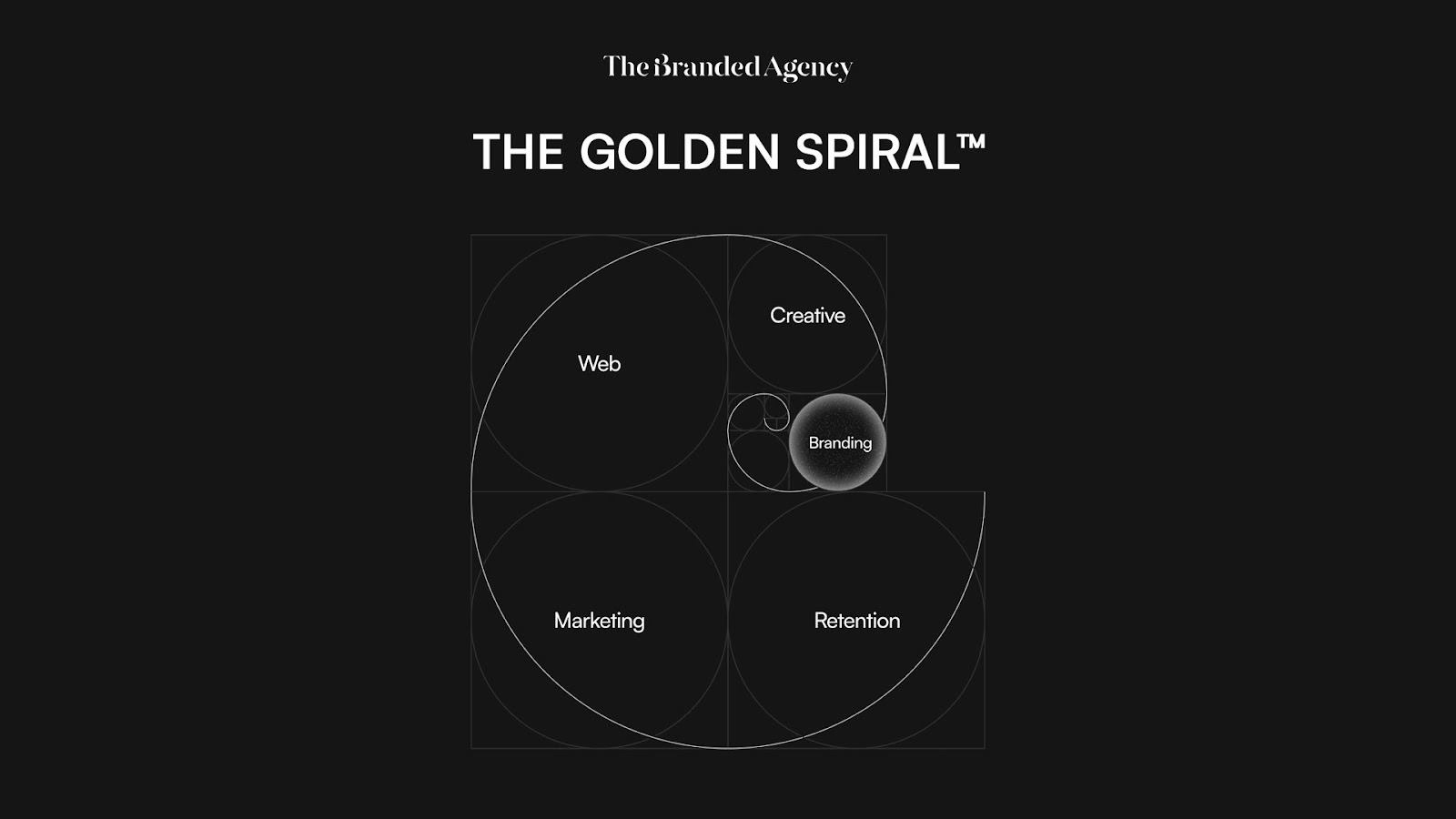
The Golden Spiral
There's a pattern in how the best consumer brands grow, and once you see it, you can't unsee it.
Brand investment makes performance marketing cheaper. Cheaper performance marketing generates more revenue. More revenue funds more brand investment. The loop compounds. Each rotation of the spiral is more efficient than the last.
Most founders try to start the spiral at the revenue step. They put money into ads before they've built any prior belief, which means they're paying full price for every customer, every time. The economics never improve. The spiral never starts.
Start at brand, and the whole system changes shape.
Strong positioning makes your creative more resonant. More resonant creative gets higher CTR. Higher CTR lowers your CAC. Lower CAC lets you reinvest in brand. Better brand makes your positioning stronger. The spiral accelerates.
This isn't theory. It's the operating logic behind every Shopify brand that has successfully scaled without becoming a discount machine. Read the full Golden Spiral philosophy before we get tactical.

What the fastest-scaling Shopify brands have in common
After working across hundreds of brands in crowded categories, a pattern shows up so consistently it stopped feeling like insight and started feeling like physics.
The brands that compound aren't the loudest. They're the most coherent. Their ads sound like their emails. Their PDPs sound like their social. Their UGC sounds like something the brand would actually say. At every touchpoint, the customer is meeting the same brand. That repetition builds familiarity. Familiarity builds trust. Trust converts, retains, and refers.
The brands that stall have the opposite problem. Not bad creative. Not wrong channels. Fragmentation. Every campaign feels like a fresh start because there's no underlying system holding the voice, the position, and the proof together.
Three things separate the compounders from the fragmenters, and none of them show up in a standard brand guidelines doc.
The first is Credibility Transfer. Early in a brand's life, the founder is the brand. Their face, their story, their point of view, their willingness to say something true about the category. This is the highest-leverage content that exists, and most founders either refuse to use it (too modest) or overuse it until the brand can't stand without them. The brands that scale past this transition map it deliberately: when to lead with the founder, when to let the brand stand alongside them, when to step back entirely. Getting the sequence right is the difference between a founder who builds a brand and a founder who becomes a bottleneck.
The second is Green Space positioning. Every Shopify category is full of brands competing for the same customers with the same claims. Clinically proven. Clean ingredients. Sustainably sourced. The words have stopped meaning anything. The brands that win find the unclaimed territory in a market, the thing no competitor is saying, and build from there. It’s the green space because that’s where the money is. Note that this is not a niche. A niche is a customer segment. Green Space is a position, and positions are harder to copy than products. Harvard Business School has a good breakdown of why brand equity built this way compounds differently than the reactive version most brands end up with.
The third is a Decision Filter. Brand erosion rarely happens in a boardroom. It happens in the small daily choices: approving copy that's slightly off, taking a partnership that feels adjacent, running a campaign that chases a trend. Over time, those decisions drift the brand away from its position in ways that don't show up in performance dashboards until the damage is done. The brands that maintain coherence at scale run every decision through one question: does this reinforce the position or dilute it? That's it. The simplicity is the point.
The five parts, in order
Sequence is a strategy. These don't work in a different order.
1. Name the Category Truth. Every category has something it keeps getting wrong. The lie the market tells, the promise that doesn't deliver, the thing everyone says but nobody actually does. Your job is to name the truth out loud. This becomes your point of view, your content engine, and your conversion lever. Write one sentence: "Every [category] brand tells you [X]. We believe [Y]." That sentence is your brand's thesis.
2. Build the Character. Your brand needs to feel like someone. Not a demographic. Not a mood board. A perspective. Three things this brand would never say, three things it always says. These guardrails go to every writer, every creative partner, every contractor who touches the voice. Non-negotiable.
3. Build the Messaging Hierarchy. Four layers: the brand promise (the transformation you deliver, not the feature you offer), the proof pillars (the three reasons to believe you), the objection crushers (the top three reasons people don't buy, answered in advance), and the hook bank (twenty-plus opening lines pulled from real customer language). One note on proof: the FTC has specific guidance on how claims need to be substantiated in social and creator contexts. Getting the proof pillars right isn't just good strategy. It's infrastructure. When this system exists, every campaign brief takes twenty minutes instead of two hours.
4. Design for Conversion. Beautiful and effective are not in conflict, but they require intentional design. Your visual system has to work in three contexts simultaneously: native feed, paid ads, and your product pages. Most brands design for one. Brand recognition is built through repetition, and repetition requires a visual system that travels. One primary color, one headline font, three words that describe your photography style. If you're building out video and shoppable content as part of that system, these are the practices that actually drive revenue rather than just views. Anyone you hire should be able to hold the brand without you in the room.
5. Measure the Brand. Branded search volume month over month. Direct traffic percentage. Returning customer rate. Email open rates on non-promotional sends. These numbers tell you whether the brand is building or stalling, and they almost always predict what your performance numbers will do before your performance numbers do it. When brand metrics drop, don't increase ad spend. Diagnose the position first.
The real reason brands stall
It's not creative fatigue. It's not algorithm changes. It's not even competition.
It's that the brand never had a position strong enough to generate prior belief, so every customer is a cold customer, and cold customers are expensive forever.
The Founder's Brand System fixes the foundation. The Golden Spiral is what happens after that.
If you're building from zero or rebuilding from a position that stopped working, this is how we approach it for early-stage and growing brands.
Build it once. The compounding is the point.
Meghan Conyers is Partner and Creative Director of The Branded Agency. Her firm's Brand-Backed Performance™ methodology integrates brand strategy with performance marketing for Shopify and DTC brands. She writes The Truth Can Make You Rich on Substack.
October 12, 2026
Related content
.jpg)
.jpg)
.jpg)
Turn your social content into a revenue channel
Turn your TikToks and Reels into shoppable videos and boost conversions by 3.5x.